Thursday, April 28, 2011

New Evidence of Ancient Civilizations Is Frequently Uncovered

Ancient cities of SumerImage via Wikipedia
A frequently used plot device in fantasy, action/adventure and science fiction is the discovery of an ancient civilization. Perhaps the most familiar example includes the many fictional adventures of Indiana Jones. A reader might wonder, with humans constantly crawling all over the globe, with 3D satellite mapping going on, and with all the other new scientific tools available, are there any amazing ancient secrets left to be discovered?

The answer is, amazing discoveries are made all the time! Just this week there are news reports that a new, unheard of ancient Sumerian city has been discovered in southern Iraq.

http://www.stumbleupon.com/su/1WrVAB/www.suite101.com/content/a-new-sumerian-city-has-been-discovered-in-southern-iraq-a230390

The ruins are located south of the Sumerian city of Eridu. Isn't it amazing that with the endless warfare in Iraq over the past few decades, the invasions and retreats involving hundreds of thousands of troops, and chaos and looting of ancient ruins, this new discovery has been made. Presumably in the years ahead, work on these ruins will help shed more light on the civilization of Sumer and Akkad some 4,000 years ago.

My fantasy novel, Gettysburg Passage, from Amazon, uses a similar plot devise to drive the fast-paced action of the narrative. Mixed together are: 1) a mysterious, powerful, newly discovered ancient artifact; 2) a strange burning cave portal found near the Gettysburg American Civil War battlefield; 3) odd, real-live sightings of long-dead famous warriors; and 4) through mystics and dreams, an appeal for help from a lost civilization from the ancient past (Sumer, Babylon, Greece, Egypt? I am not saying!).

Read the reviews and check out a free, sample chapter. http://www.amazon.com/Gettysburg-Passage-ebook/dp/B00408AOMW

Gettysburg Passage, only $2.99 from Amazon.
Enhanced by Zemanta

Wednesday, April 27, 2011

Found Treasure & Ancient Artifacts Are Not Just the Stuff of Fantasy Novels

Merovingian buckle, 7th century; bronze plated...Image via Wikipedia
You may have missed this news over the long Easter Weekend....several years ago a man enlarging his backyard garden pond in Austria dug up obviously old artifacts -- jewels and rings and belt buckles and silver plate and the like. He didn't bother to clean them, just placed the dirt encrusted objects in a box. He stored them in the basement and like most of us who store stuff in the basement, he forgot about it. Then he recently decided to move and in his moving preparations he came upon the box again. He cleaned up the artifacts and found....treasure! Ancient treasure! Treasure and artifacts now being called invaluable and something out of a fairy tale. Stuff more than 650 years old. Buried in his back yard. The treasure trove will soon be on display at the Presidential Palace in Vienna.

Here is a link to the story: http://www.pasthorizons.com/index.php/archives/04/2011/significant-mediaeval-treasure-found-in-austria

Who could make this stuff up?

The fantasy novel, Gettysburg Passage, available from Amazon, actually has a similar plot twist.

A group of friends living around Washington, D.C. have their lives changed when one of them finds an ancient artifact. This artifact is not jewelry, but rather an ancient royal staff or mace -- a symbol of authority and power. The artifact still has power, in fact, and begins to affect their lives in amazing ways. Actually, the mace appears to be drawing them to a mysterious cave near the Gettysburg battlefield just north of Washington. The mace and the cave come together to draw the friends into an opportunity -- save an ancient civilization and at the same time perhaps preserve the modern, complex, interconnected world we know today in the 21st Century.

Will the friends take advantage of the opportunity to make history? Find out by reading a free sample chapter of the book at Amazon.com today. Read the reviews, read a sample chapter or buy Gettysburg Passage, only $2.99. Book link: http://www.amazon.com/Gettysburg-Passage-ebook/dp/B00408AOMW
Enhanced by Zemanta

Around 6 million years in Africa human history began

History of human specie - Skulls and fossilesImage via Wikipedia
That is the central nugget of a wonderful new essay in The Guardian, one of the UK's leading newspapers, a thoughtful media portal better than anything in America today. Basically, you have to go back some 6 million years to find a common chimp-human ancestor. Since then, humans have been on a separate path that has led -- with many branches and dead ends -- to where we are today.

The link to the essay is here: http://www.guardian.co.uk/science/2011/apr/25/evolution-human-history-apes  The essay is called The Untold Story of Evolution but of course the story has been told many times and is discussed daily in classrooms. It is well written and honestly addresses they many puzzles and questions still bedeviling scientists. What drove the ancestors out of Africa? What led to upright walking? Why the long legs and large brain? What sparked the creation of human language?

What I like about the topic are the many "holes in the data." Why did humans begin burying the dead? Why did we begin to believe in life after death? Where were the first societies located where complex communities came into being?

In my novel, Gettysburg Passage, I envision a group of five friends -- two couples and a priest -- who are suddenly linked to a complex, ancient society. These friends don't yet realize it, but when they find an artifact in downtown Washington, D.C., they are magnetically drawn, through dreams and other evidence, to a portal that gives them access to our complex past -- if they choose to go.

One of the friends knows all about this ancient history because he's been there before -- but he's not talking about it unless he has to. Unfortunately for him, the past begins to come alive in modern Washington. In a strange twist, the portal exists as a burning cave located near the Gettysburg battlefield. This leads to all kinds of modern mayhem, including several Civil War characters suddenly making appearances in today's modern world. And just in time for helping to celebrate the 150th Anniversary of the beginning of the Civil War ;-)

Gettysburg Passage is available from Amazon.com for $2.99 US. It is a thoughtful, fast-paced fantasy novel that has received some very good reviews. Why not sample a free chapter? Go here to check it out. Thank you!
Enhanced by Zemanta

Saturday, April 16, 2011

Civil War Commentary and Fantasy Fiction

Photograph showing the front side of Arcadia P...Image via Wikipedia
There is interesting commentary in a South Carolina newspaper -- a state known for its defensiveness about its complex and combative history -- that you might wish to check out. His thesis is that many "top of mind" opinions on America's bloodiest war are too simple. Southerners want to talk about anything but slavery. On the other hand, during the time of the hostilities, citizens of the North harbored incredibly racist attitudes that would be considered intolerable today. It was an ugly time. Here is a link to his column. Another story in The Washington Post is a review of Gary Gallagher's new book, The Union War. In that book it is documented that Northern attitudes were also complex -- and generally not so pure. Essesentially, Northern soldiers went to war to preserve the country. Emancipation was secondary. Here is the Post link.

While you are checking out those thoughtful pieces of journalism, please consider also checking out my modern action-fantasy novel, Gettysburg Passage, only $2.99 from Amazon. Gettysburg Passage is a fast-paced modern story of people discovering an ancient artifact with mysterious powers. That artifact turns out to be a "key" that opens a portal to save a lost civilization. The portal happens to be very close to the Gettysburg Civil War battlefield.....all kinds of mayhem ensues!! Check out the great reader reviews here or try a sample chapter from the Amazon book site.
Enhanced by Zemanta

Wednesday, April 13, 2011

Civil War Intrudes on Modern Day Adventure Novel

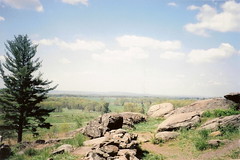
View from Little Round Top over Gettysburg Bat...Image by Ken Lund via Flickr
The American media has re-discovered the Civil War. It happens every 25-30 years, especially around major anniversaries like 150th year of the start of the conflict. While the war has always been popular in nonfiction, it's not a typical setting for a lot of mainstream novels today.

It was with some anxiety that I named my fantasy novel Gettysburg Passage. While Gettysburg, PA plays a role in the climax, I was afraid many potential readers would assume the novel was strictly in the genre of war-related historical fiction -- which is actually a secondary influence.

Gettysburg Passage, from Amazon,  is really about how a group of modern people living around Washington, D.C., New England and Paris, come to a decision about whether to help out -- or not -- the remnants of a mysterious society about to be overwhelmed by barbarous invaders. That society is potentially reached through a portal found near the Gettysburg battlefield. And the historical battle plays a role in the modern-day decision to help out or not.

So to the extent the Civil War anniversary draws some attention to Gettysburg Passage -- that is a good thing. Just remember that the book, just $2.99, is also a fast-paced, modern-day fantasy, action and adventure e-novel, with a dash of Civil War action thrown in for good measure. Go to Amazon.com and try out a sample chapter today!

Find Gettysburg Passage reader reviews here.
Enhanced by Zemanta

Monday, March 28, 2011

Life Is Stranger Than Fantasy Fiction

This is the cover to the January 1953 issue of...Image via Wikipedia
Some people are relunctant to regularly read fantasy novels -- even books where 98% of the plot is reality-based -- because they find it difficult to accept the "fantastic" element. In this case, fantastic means odd, fanciful or supernatural. In many cases the 2% fantasy is based on science speculation, such as other dimensions, wormholes or alternative universes. In all of these examples, however, respected science predicts they are actually possible.

Current news items re-inforce my point. For example, today it was announced that scientists at the University of York have recovered the remains of an Iron Age man's brain, buried in soil that remarkably preserved critical soft tissue. Most experts would tell you the chances of finding a partially preserved brain that old under those circumstances were highly unlikely. But they did. Here is a link to the news release: http://www.sciencedaily.com/releases/2011/03/110328101108.htm

In another current example, here in America each spring universities compete in a winner-take-all basketball tournament called March Madness. Sixty eight teams compete until a champion is crowned. We are at the moment down to the last four standing, called The Final Four. Two of them are extreme long shots and the other two were not expected to get this far. Odds makers are quoted on ESPN, the American sports network, as saying the finalists are so improbable that he placed the odds of it happening at 1-in-300 million. But it did happen. Fantastic. Here is a link to the story: http://espn.go.com/blog/collegebasketballnation/post/_/id/28764/so-just-how-unlikely-is-this-final-four

So take a chance and broaden your horizons. The next time you consider reading a really good, fast paced novel, consider a good fantasy novel, instead of the usual detective or political thriller fiction. The odds are, the fantasy plot is believable and the experience will be enjoyable. For example, try Gettysburg Passage, a fantasy novel just $2.99 from Amazon. Read the reviews here.
Enhanced by Zemanta

Wednesday, March 23, 2011

How We Got Here and "God Had a Wife"

An 'Asherah' figurineImage via Wikipedia
Active in the news this week are stories about the ongoing discovery of additional evidence that the ancient Hebrew God, Yahweh --the monotheistic God-the-Father of Judaism and Christianity -- had in fact a female consort named Asherah, also known as Istar. There are several brief references to her in the Hebrew Bible. Modern researchers such as Bible scholar Francesca Stavrakopoulou claim that references to Asherah were mostly deleted from sacred texts to promote a male-centered view of religion. Nearly all ancient religions start with female god figures but over time the concept of God seems to go gender neurtral of lean towards the God-the-Father bias. Clearly male-directed editing has occurred.

http://www.telegraph.co.uk/culture/tvandradio/8398099/Bibles-Buried-Secrets-Did-God-Have-a-Wife-review.html

http://newsfeed.time.com/2011/03/22/fertility-goddess-asherah-was-gods-wife-edited-out-of-the-bible/

Just more evidence that "how we got here," our prejudices, our viewpoints, our beliefs, are a complex stew handed down over thousands of generations. As we go back into the mists of time, we find dynamic activity in concepts of individuality, personal freedom, moral accountability and our place in the universe. Many of these issues are addressed in my fantasy fiction adventure, Gettysburg Passage, just $2.99. To read reviews, try a sample chapter or just learn more, please go here.
Enhanced by Zemanta

Wednesday, March 16, 2011

GibraltarImage via Wikipedia
In the news this past week has been reports that the lost civilization of Atlantis has possibly been discovered near the ancient and hauntingly beautiful Spanish coastal city of Cadiz. Atlantis, popular in song, poetry, literature and film, is a legendary island civilization first mentioned in Plato's dialogues, Timaeus and Critias.


In Plato's account, Atlantis was a naval power lying "in front of the Pillars of Hercules" -- modern Gibraltar --and Atlantis conquered many parts of Western Europe and Africa 9,000 years before the time of Solon, or approximately 9600 BC. After a failed attempt to invade Athens, Atlantis sank into the ocean "in a single day and night of misfortune" -- supposedly a giant tsunami similar to what just battered northern Japan. Without a doubt much of Plato's account is fanciful.

To help solve this ancient riddle, The National Geographic Society funded a discovery search centered around huge marshlands in Dona Ana Park. There, underground, researchers said they believe that they have discovered the ruins of Atlantis deep underground. Scientists used the latest technical tools in their search, including deep-ground radar, digital mapping, and underwater technology to survey the site.

Some experts and commentators are challenging these findings as hype for National Geographic's TV special. Cable TV is notorious for poorly-researched "history" specials promoting marginal science and paranormal phenomena. However, what I find interesting is that SOMETHING is down there beneath the ground. Since Cadiz has been inhabited for more than 3,000 years -- by Phoenicia, Rome and Carthage -- it is entirely possible that some kind of lost civilization resided there that has been totally lost to modern history.

There is so much about our past that we don't know. Which brings me to my fantasy novel, Gettsyburg Passage, from Amazon, an ebook for just $2.99. In the novel, friends living around Washington, D.C. come across an ancient artifact that threatens to totally disrupt their everyday lives. It appears this artifact -- an ancient staff or mace -- is a sort of "key" to a lost civilization that may be in need of immediate assistance. The portal to this ancient civilization may be found near or in a burning, abandoned coal mine very close to the Gettysburg Battlefield just north of Washington. Hmmmm. All kinds of strange and interesting things are about to happen.

Reviewers are loving the book, calling it a quick and interesting read. Read reviews on the Amazon website here. Gettysburg Passage. Sample a few chapters or buy it today. Just $2.99 on your ereader.


Enhanced by Zemanta

Sunday, March 6, 2011

Gobekli Tepe and the relentless human march towards establishing civilization

The sculpture of an animal at Gobekli Tepe, cl...Image via Wikipedia
Gobekli Tepe is the oldest known temple in the world and possibly a first and most important step towards creating a Western-style civilization. There are some great links below where you can see some amazing photos of this temple town, pillars and monoliths of amazing beauty -- and more than 11,000 years old!

Ninety-nine percent of the human race has never heard of this amazing archaeological site. Take a look:
http://www.environmentalgraffiti.com/archaelogy/news-gobekli-tepe-worlds-oldest-temple

There are early civilizations that you have never heard of....they don't cover them in your history books. That is the reality behind my fantasy novel, Gettysburg Passage, from Amazon. There is a forgotten, abandoned coal mine very near the Gettysburg battlefield that is burning with deep, underground fires. What is causing this inferno? Weird things are also going on as some friends living around Washington, D.C. find an ancient artifact that may be somehow linked to the mysterious mine. Long-dead famous people begin appearing in ways that don't seem possible. An ancient civilization -- facing ruin -- cries for help.

Read reviews for Gettysburg Passage here. From Amazon, only $2.99.

http://en.wikipedia.org/wiki/G%C3%B6bekli_Tepe
http://www.smithsonianmag.com/history-archaeology/gobekli-tepe.html
http://www.archaeology.org/0811/abstracts/turkey.html
Enhanced by Zemanta

Wednesday, March 2, 2011

Escape By Horse! Would 8 Million People Notice?

Washington, D.C. (Sept. 26, 2003) - Aerial vie...Image via Wikipedia
Washington, D.C. is a big town, with a population density of approximately 10,000 people per square mile and a metropolitan population of more than 8 million people.  If a person in the Washington suburbs was being menaced by two murderous thugs, do you think that person could successfully escape using a horse, and not be noticed?

This is Rick Reynolds' quandry. Rick is alive today in the Washington suburbs, an avearge guy, about 30 years old. He is reasonably handsome and strong, has a good job and several interesting and equally sucessful friends. Rick has a good life but a secret in his past is coming back to haunt him. He happens to be carrying an ancient artifact that could be super valuable in the wrong hands. Rick realizes that any potential public drama or violence will cost him his hard-earned job and comfortable life. He wants to escape the pursuers and dump the artifact in a place where it can never be found. To get there, he has to cross the metro area, south to north. There are about 8 million people between Rick and the dump site, a burning abandoned mine near the Gettysburg, PA, battlefield park.

Remember, Rick needs to lose the pursuers and not draw unnecessary attention to himself or his task. Oh yeah, at some point in the chase, he has to travel, on a tight deadline, from Virginia to Maryland to Pennsylvania using a "borrowed" horse. And not be noticed! Is this possible? Actually, this chase is a central scene in the book and is absolutely realistic, based on the capabilities of a good, strong horse, available greenspace, potential places to ford the Potomac River and fortuitous directions and routing.

In other words, today in 2011 you can ride a horse from the southern suburbs of Washington to the northern suburbs all the way into Pennsylvania and not draw a lot of attention. But you have to be saavy and maybe a little bit lucky!

Along the way, you might meet famous Civil War figures, generals and everyday soldiers, world famous Indian fighters, authors and maybe even a future Supreme Court justice. You may even stumble into a Rebel-Yankee skirmish or two! So pack your Colt .44, your cavalry saber and maybe your favorite iPhone GPS app, saddle up and come along for a fast-paced, amazing ride!

Gettysburg Passage, adventure-fantasy fiction, by John Callahan, available from Amazon for just $2.99. Download a sample chapter or read the many positive reviews by readers here.

Concepts discussed in the book: ancient, lost civilizations, Babylon, Indo-Europeans, the Civil War, Gettysburg, Western Civilization, Hittites, time travel, archaeology, ancient and modern weapons, car chases, philosophy, religions, Ark and Dove, Maryland colonization
Enhanced by Zemanta

Monday, February 28, 2011

How Would We Be Perceived to the Iceman?

Very free reconstructions of equipment said to...Image via Wikipedia
Oetzi the Iceman, the famous middle aged man frozen into a glacier more than 5,000 years ago, and found in the Alps in northern Italy in 1991, stood about 5 feet tall, or about 1.6 meters. Oetzi weighed a little more than 100 pounds, or about 50 kilogrammes, at his death. Experts tell us he was average for his time. Five thousand to 10,000 years ago the earth warmed and civilizations began to form. For the descendants of Indo-European culture, this was the period that our early vocabulary was created, myths were created and repeated around evening fires and the serious rumblings of spirituality and civic organizations began to be conceived.

In fantasy fiction and cinema, adventurers from modern times sometimes find themselves somehow transported back in time to this period. What is not often addressed is that we would be giants to average folks back then. In my fantasy novel, Gettysburg Passage, an Amazon ebook, Rick Reynolds, a key character, is being drawn to action that takes place somewhat earlier than Oetzi the Iceman's time. If Rick could go back in time, given his modern size, intelligence, experience and wisdom, might earlier inhabitants be tempted to worship him as a god among men, or be tempted to at least make him king?

Check out the many positive reviews for Gettysburg Passage from Amazon, sample a few chapters, or download the book, only $2.99. Find the book summary, reviews and other key information at :
http://www.amazon.com/Gettysburg-Passage-ebook/dp/B00408AOMW/ref=sr_1_1?ie=UTF8&m=AG56TWVU5XWC2&s=digital-text&qid=1298940804&sr=1-1


Enhanced by Zemanta

Sunday, February 27, 2011

The Moment of Decision Shared: Revolution and Fantasy Fiction

EGYPT-LIBYA BORDER, LIBYA - FEBRUARY 24:  A Li...Image by Getty Images via @daylife
Across the Middle East and North Africa many have made individual, often painful and always risky decisions to join protests against autocratic regimes in Tunisia, Egypt, Jordan, Bahrain, Yemen, Libya, Iran and Syria. They lost sleep, discussed risks with loved ones, asked opinions of friends and family and then made the decision to act or not.

For hundreds of thousands of people, the decision to march, to demonstrate, "to be counted," has been a positive, affirming decision with few negative consequences. Governments have fallen. But for several thousand brave but unfortunate young men and women, the decision to be counted has carried a painful cost. In Egypt, hundreds died. In Iran, many are detained. In Libya, perhaps thousands of innocent citizens are dying.

The lonely decision of one person, or maybe a few friends, to act, to help, to right a wrong, to make the world a better place, is the central dilemma in my fantasy novel, Gettysburg Passage, by John Callahan, a Kindle ebook from Amazon. The people who stand up for something better, who decide "to be counted" have a name in any society: heroes. They are all ages and come from all walks of life. In Gettysburg Passage they are Rick Reynolds and his friends, about 30 years old, employed, well educated. They are successful, comfortable and content. Why rock the boat?

Because a lost people need their help and it is the right thing to do. Gettysburg Passage, perhaps a civilization will be saved. Just $2.99, from Amazon. Read book reviews here.


Enhanced by Zemanta

Wednesday, February 23, 2011

Pictures at an Exhibition, or Just Fantasy?

Viktor Hartmann, Paris Catacombs. People pictu...Image via Wikipedia
Recently a man living near Washington, D.C., experienced an unwelcome and alarming vision. Friends laughed it off and dismissed it as a dream, perhaps a fantasy or an illusion. The vision was clear: good people were in danger and needed his help. He and perhaps his friends were somehow destined to get involved. The appeal came through a discovered artifact -- ancient and very valuable. The artifact created clues and led to glimpses of places lost and people long dead, including war heroes, statesmen and jurists. The main character, and maybe his friends, are compelled to follow unmistakable signs leading to a burning cave situated near the famous Gettysburg battlefield park north of the American capital.

More than 100 years earlier, in Russia, a flawed yet gifted and not quite famous composer grasped a similar vision. He was Modest Petrovich Mussorgsky, in poor health and suffering from depression, alcoholism and delirium. Yet in just a few weeks Mussorgsky composed the immortal "Pictures from an Exhibition – A Remembrance of Viktor Hartmann", in memory of a dead artist friend. Most of Hartmann's paintings -- the pictures which inspired the musical composition -- are now lost to history, particularly one mysterious pastel that Mussorgsky was obsessed with to his last days, a work depicting an abandoned cave, raging with suppressed fire, with furious armies clashing at its base. If you looked closely into the cave, it was said you had the illusion of looking into a lost world, perhaps a parallel universe....the painting was last spotted in the black market Istanbul in 1933....and said to be purchased by a fabulously wealthy Syrian collector...

Gettysburg Passage is a fantasy novel by John Callahan, available for Kindle and all e-readers from Amazon for $2.99.
Enhanced by Zemanta

Friday, February 11, 2011

Super Wolf Packs Are Not Just The Stuff Of Fantasy Novels

Mollies Pack Wolves Baiting a BisonImage via Wikipedia
Media stories out of Russia and Europe claim that a super wolf pack numbering nearly 400 animals has recently killed more than 30 horses and is menacing the far north Verkhoyansk district in Russia, where temperatures often drop to more than -100F. Since a typical wolf pack numbers between 6 and 7 animals, naturalists are puzzled, but speculate that the harsh winter has limited natural food supplies, such as rabbits and mice. The ranchers' livestock has become easy prey.

A key action scene in my fantasy novel Gettysburg Passage involves proto wolves in a super pack that menaces a group of Americans visiting a mountain cabin for the weekend. When I wrote the scene I was worried about putting wolves in a bad light. There are many wolf defenders and I sympathize with them -- but clearly wolves are predators and should be treated with healthy respect...and at a distance!

Gettsbury Passage -- a few modern, young professionals are called upon to help save a threatened, lost civilization. Will they act, or choose to stick with their careers and comforts of home and friends. The ebook is a quick, action-packed read and on sale at Amazon for just. $2.99. To learn more, go here.

Here are wolf pack story links:

http://bit.ly/gzPSgt
http://bit.ly/hG7L26
http://bit.ly/i8ncQN


Enhanced by Zemanta

Thursday, February 10, 2011

Tokens Link Us Deep Into the Mists of the Ancient Past

For tens of thousands of years, humans have buried the dead with precious objects: jewels, weapons, musical instruments, amulets -- even pets. Vikings carried around Stone Age objects as good luck charms and were buried with them -- linking themselves to the dim and mysterious past of their ancestors. The custom was mentioned as being active even in Shakespeare's time and was described in Ophelia’s burial scene. In our modern age people still find lucky charms and keep them close. We act in similar ways to our ancestors from long, long ago.

In the fantasy novel, Gettysburg Passage, an ancient, precious -- possibly miraculous -- object upends the everyday existence of a group of friends. See what happens when Civil War people and places suddenly become too real, and an ancient civilization beckons for acknowledgement and assistance.

To learn more about Gettysburg Passage, go here.


Enhanced by Zemanta

Wednesday, February 9, 2011

Fantasy fiction, or do grande civilizations simply disappear?

Mozambican coat of armsImage via Wikipedia
The Grande Hotel da Beira in Mozambique in the 1950s and 1960s was considered the most glamorous hotel in all of Africa. A sun-burned, gleaming jewel on the Arabian Sea. Then Portugal, after 400 years, recognized the right of home rule, and left. A civil war ensued and the region experienced long-term war and anarchy. Today, the hotel is home to several thousand people living a life of subsistence. Trees grow out of the roof. All windows, wiring and pipes have been ripped out and sold. Only forlorn and fragmentary evidence hints of a "grande" past.

A current image of the former hotel can be found here.

A foundation of the fantasy novel, Gettysburg Passage, is that in the distant past, a "grande" civilization flourished after the great glaciers receeded. This civilization had independently worked out many of the underpinnings of Western Civilization -- before it was beset by plagues, infighting and invasion.  Somehow, this lost civilization -- through the discovery of a mysterious royal staff or mace -- extends a link through space and time to modern-day America. People are given the opportunity to get involved. Perhaps, to play a role in seeing that this ancient civilization isn't completely destroyed. Improbably, America's most sacred battlefield park, Gettsyburg, and maybe the battle itself, becomes part of the action.

Civilizations rise, like Egypt, like Babylon, like Rome, like the U.S., they are tested, and most fall. Not all are remembered. The forgotten may reach out to us -- even today. Gettysburg Passage, available on Amazon.com. To learn more, visit here.
Enhanced by Zemanta

Wednesday, January 19, 2011

Stone age projekt in Sweden 5Image via Wikipedia
As noted previously, adventurous and fun-loving humans have made a priority out of making and consuming wine and beer for at least 10,000 years. The National Geographic News highlighted this bit of history this month with a report on the world earliest known winery complex -- in a cave in ancient Armenia. Here's a link to the cave discovery:  http://bit.ly/gD7tRV

And here's a link for news on the search for the oldest cultivated grapes going back to the Stone Agehttp://bit.ly/9anTbU 

Wine and beer have lubricated family get togethers, social ceremonies and religious observances going back to the earliest human societies. In the fantasy novel Gettysburg Passage, one key character, Father Matt, shows a deep appreciation for wine's religious and social powers. The priest also has a special appreciation for a mysterious and ancient artifact that shows up at his door on day. This discovery draws in a wider circle of friends, acquaintances and threatening characters and leads them all on a wild chase from the Washington area to the hills overlooking Gettysburg, America's most sacred battlefield.

Gettysburg Passage is receiving positive attention as a fast-paced action-adventure fantasy novel available on Amazon.com. Check out the reviews on Amazon or in the media and see if you might want to explore for yourself the mystery linking a sacked and over-run ancient society desperately in need of outside help, a Biblical-like prophesy reaching out to the 21st Century and a burning cave in the hills overlooking modern-day Gettysburg.

Here is a link to Gettysburg Passage on Amazon: http://www.amazon.com/Gettysburg-Passage-ebook/dp/B00408AOMW
Enhanced by Zemanta